> For the complete documentation index, see [llms.txt](https://docs.rillet.com/EjmEP4KZ9BVp9j2ho4Mh/llms.txt). Markdown versions of documentation pages are available by appending `.md` to page URLs; this page is available as [Markdown](https://docs.rillet.com/EjmEP4KZ9BVp9j2ho4Mh/accounts-receivable/contracts/managing-contracts.md).
# Managing Contracts
Once a contract is created in **Rillet**, you can edit, amend, end, or delete it, or review its financial impact, to keep your revenue recognition, invoicing, and audit trail accurate as circumstances change. Choosing the right action matters, since each one affects your contract history and reporting differently, and using the wrong one can distort your revenue records or leave gaps in your audit trail.
### Decide Which Action to Use
The right action depends on why you're changing the contract, not just what you want the end result to look like:
| Action | Use When | Why |
| -------------------------------- | ------------------------------------------------------------------------------------------------------------------------------------------------------------------------------------- | ----------------------------------------------------------------------------------------------------------------------------- |
| [**Edit**](#edit-a-contract) | The contract was entered incorrectly from the start, or you need to update admin details (invoicing frequency, payment terms, addresses, email recipients, revenue period on a line). | Fixes the contract directly, without leaving an amendment record behind. |
| [**Amend**](#amend-a-contract) | The commercial terms genuinely changed mid-term: a price or quantity change, a new product, an upsell, or a shortened term. | Keeps the original contract on file as a read-only record and carries the new terms forward with a reason and an audit trail. |
| [**End**](#end-a-contract) | The contract is open-ended or auto-renewing (no end date) and needs to stop. | Works only for contracts with no end date, and sets a termination date going forward. |
| [**Delete**](#delete-a-contract) | The contract was created in error. | Removes the contract entirely. |
### Edit a Contract
Follow these steps to edit a contract and update details such as duration, terms, or associated products:
1. Click the **three dots** (•••) next to the contract you want to edit.
2. Select **Edit Contract** from the dropdown menu.
3. Modify the necessary **Contract Details**, keeping in mind that what you can edit depends on the contract's status:
* **Active** (no invoice paid yet, and no revenue recognized in a closed period): every field is editable, and Rillet regenerates the invoice schedule from scratch.
* **In Effect** (an invoice has been paid, or revenue has landed in a closed period): line items become read-only, though you can still update the revenue period, invoicing, and address/email fields.
* **Billing and Shipping Addresses**: updated from the contract's **Invoicing** tab, not from the invoice itself, since invoices don't let you change the address directly. These fields stay editable even when the contract is In Effect, though address options are limited to addresses already saved on the customer record. See [**Create a New Invoice**](/EjmEP4KZ9BVp9j2ho4Mh/accounts-receivable/invoicing-and-payments/create-a-new-invoice.md) to learn how an address change here flows through to existing invoices.
* **SSP per unit**: editable on an **Active** contract from each product line's **SSP** section on the **Products** step, to override that product's SSP for this contract. It becomes read-only with the rest of the line once the contract is **In Effect**.
* Blocked entirely if any invoice or revenue entry for the contract falls inside a closed accounting period (or a locked AR subledger period, for organizations with subledger locking enabled).
4. Click **Confirm Contract** to save your changes.
{% hint style="info" %} **Note:**
If the deal itself changed rather than a correction, use [**Amend**](#amend-a-contract) instead so the change is captured with a reason and preserved in the contract's history.
{% endhint %}
Editing updates the contract in place without creating a historical record, so it is best reserved for corrections rather than genuine deal changes.
### **Amend a Contract**
Use these steps to amend a contract without deleting the original agreement:
{% hint style="warning" %} **Warning:**
Amend when commercial terms genuinely change partway through, such as a price or quantity change, a new product, an upsell, or a shortened term. The amendment date must fall inside an open accounting period within the contract's existing start and end dates, and amendments aren't yet supported for usage-based contracts without a credit bundle or for contracts using product bundles.
{% endhint %}
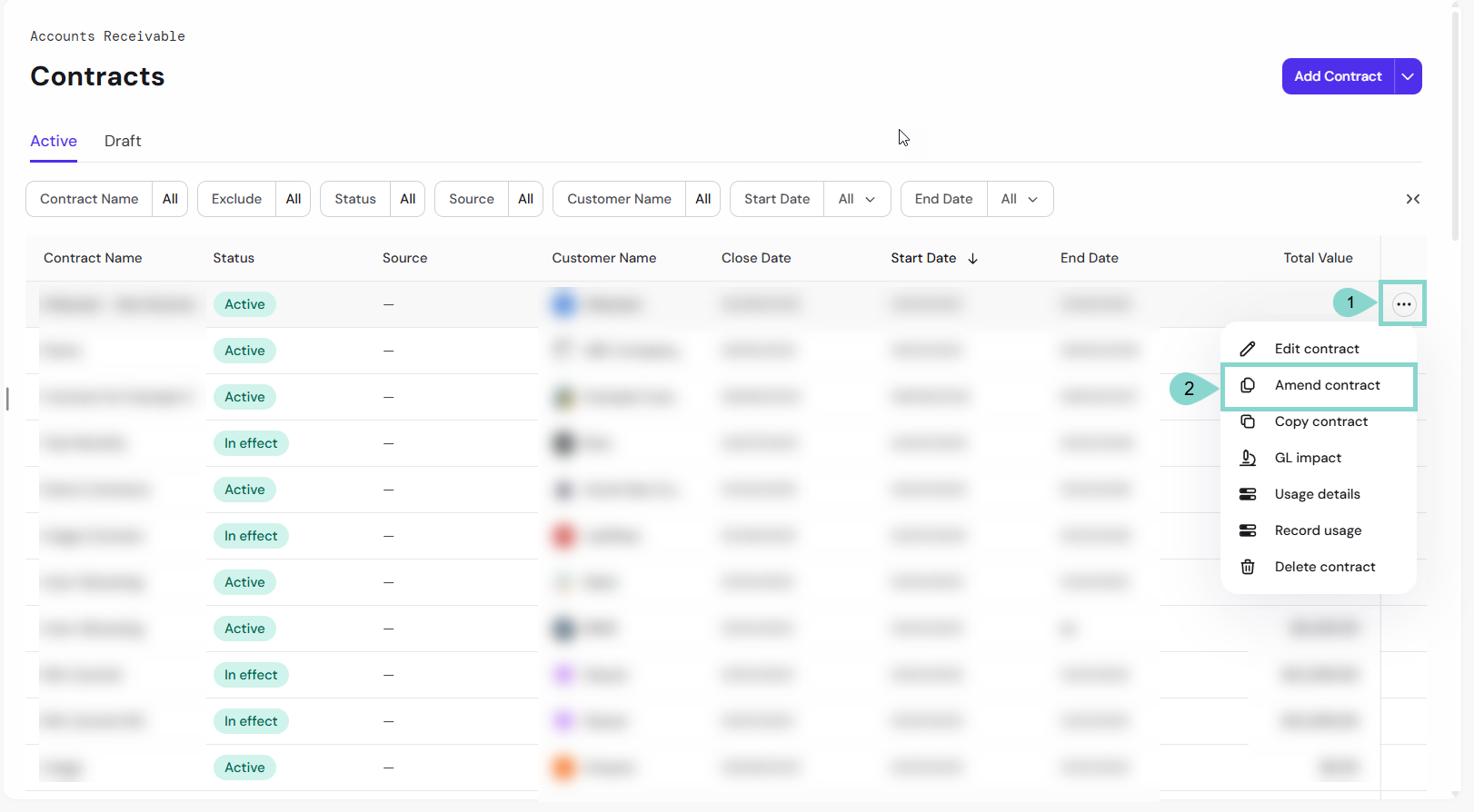
1. Click the **three dots** (•••) next to the contract you want to amend.
2. Select **Amend Contract** from the dropdown menu.
3. Click the **Continue** button.
4. Enter the **Amendment Reason**.
5. Update the necessary fields.
6. Click **Confirm contract** to finalize the changes.
When you click **Confirm contract**, the confirmation dialog describes this step as terminating and archiving the original contract, then creating a copy. This is not data loss. Your changes carry over to the new copy, and the original remains on file for audit purposes.
### **End a Contract**
Follow these steps to end a contract with no end date, such as an open-ended or auto-renewing contract:
1. Click the **three dots** (•••) next to the open-ended contract you want to end.
2. Select **End Contract** from the dropdown menu.
3. Enter the end date you want to apply.
4. Click **Confirm** to finalize the change.
Once confirmed, any invoices dated after your chosen end date are deleted, and **End Contract** will be blocked (use [**Amend**](#amend-a-contract) with an earlier end date instead if the contract already has one defined) if any of the following apply:
| Blocking Condition | Detail |
| ------------------------------------------ | ------------------------------------------------------------------------------------------ |
| **Usage commitment** | The contract has a contract-level usage commitment. |
| **End date before line item end** | Your chosen end date falls before a line item's own end date. |
| **End date before latest invoiced period** | Your chosen end date falls before the latest month that's already been invoiced. |
| **Payment or credit already applied** | An invoice dated after your chosen end date already has a payment or credit applied to it. |
If you run into one of these, resolve the conflicting invoice or payment first.
### **Delete a Contract**
Complete these steps to delete a contract created in error or no longer valid:
1. Click the **three dots** (•••) next to the contract you want to delete.
2. Select **Delete Contract** from the dropdown menu.
3. Confirm the deletion by clicking **Delete** or **Cancel** if you don't wish to proceed.
### **View GL Impact**
Take these steps to view the GL Impact and download it in XLSX format for further analysis:
1. Click the **three dots** (•••) next to the contract you want to analyze.
2. Select **GL Impact** from the dropdown menu.
3. Review the report that appears, displaying the following columns:
* **Account #:** The account number associated with the transaction.
* **Account:** The account name corresponding to each transaction.
* **Date:** The date of the transaction.
* **Transaction ID:** An identifier for the transaction.
* **Description:** A brief description that typically includes the contract name and product.
* **Debit:** The amount debited from the account.
* **Credit:** The amount credited to the account.
4. Click **Export** in the upper-right corner of the **GL Impact** window to download the report for further analysis.
Together, these actions let you keep contracts accurate and up to date throughout their lifecycle, from initial edits and amendments to ending open-ended agreements and reviewing financial impact.
### Frequently Asked Questions (FAQ)
If I amend a contract, does it change the revenue or invoices already recorded in past periods?
No. An amendment is always prospective, meaning it only changes the schedule from the amendment date forward. Any revenue already recognized or invoices already issued in prior periods stay exactly as they were and are never restated.
How does Rillet allocate revenue across multiple products in a contract?
Each product line shows a **Total SSP** and an **Allocated Revenue** amount. Rillet allocates the contract's total value proportionally based on each line's Total SSP, not its stated price, so a line with a higher Total SSP gets a proportionally larger share of the allocated revenue.
Can I override a product's SSP on a single contract?
You can override a product's SSP on an individual contract by entering a new value in **SSP per unit**, in the product line's **SSP** section on the contract's **Products** step. This works when you create a contract or edit an **Active** one. Rillet then recalculates the **Allocated Revenue** of every product line, while the product's price and the contract's total value stay the same. Once a contract is **In Effect**, its product lines are read-only, so the SSP can no longer be changed through an edit.
Does exporting my Contracts list show which subsidiary each contract belongs to?
Exporting your Contracts list includes a Subsidiary ID column, so you can tell which subsidiary each contract belongs to. Rillet delivers the export by email rather than as an instant download, so after clicking **Export**, click **Send by email** and check your inbox for the file.
### **See Also**
To learn more about managing contracts in **Rillet**, review these articles:
* [**Add a Contract**](/EjmEP4KZ9BVp9j2ho4Mh/accounts-receivable/contracts/add-a-contract.md)
* [**Copy Contracts**](/EjmEP4KZ9BVp9j2ho4Mh/accounts-receivable/contracts/copy-contracts.md)
* [**How to Create An Auto-Renewing Contract**](/EjmEP4KZ9BVp9j2ho4Mh/accounts-receivable/contracts/how-to-create-an-auto-renewing-contract.md)
* [**View GL Impact for Usage Cycles**](/EjmEP4KZ9BVp9j2ho4Mh/accounts-receivable/contracts/view-gl-impact-for-usage-cycles.md)
* [**Smart Contract Upload**](/EjmEP4KZ9BVp9j2ho4Mh/accounts-receivable/contracts/smart-contract-upload.md)
* [**Generate 606 Analysis in Rillet**](/EjmEP4KZ9BVp9j2ho4Mh/accounts-receivable/contracts/generate-606-analysis-in-rillet.md)
* [**Import Contracts in Bulk**](/EjmEP4KZ9BVp9j2ho4Mh/accounts-receivable/contracts/import-contracts-in-bulk.md)
---
# Agent Instructions
This documentation is published with GitBook. GitBook is the documentation platform designed so that both humans and AI agents can read, navigate, and reason over technical content effectively. Learn more at gitbook.com.
## Querying This Documentation
If you need additional information that is not directly available in this page, you can query the documentation dynamically by asking a question.
Perform an HTTP GET request on the following URL with the `ask` and `goal` query parameters:
```
GET https://docs.rillet.com/EjmEP4KZ9BVp9j2ho4Mh/accounts-receivable/contracts/managing-contracts.md?ask=&goal=
```
`ask` is the immediate question: it should be specific, self-contained, and written in natural language.
`goal` is what the user is ultimately trying to achieve, the reason they need the answer. Sharing it helps GitBook give you a better, more relevant answer. A goal is most helpful when it describes the outcome the user wants rather than restating the question. For example, with `ask=how do I create an API token`, a goal like `build a script that syncs our docs to a CMS` lets GitBook tailor the answer to that use case.
The response will contain a direct answer to the question and relevant excerpts and sources from the documentation.
Use this mechanism when the answer is not explicitly present in the current page, you need clarification or additional context, or you want to retrieve related documentation sections.